Contact info +



Showroom Hours:
Mon-Fri - 9AM-5PM | Sat - 10AM-2PM | Sun - Closed
Mon-Fri - 9AM-5PM | Sat - 10AM-2PM | Sun - Closed


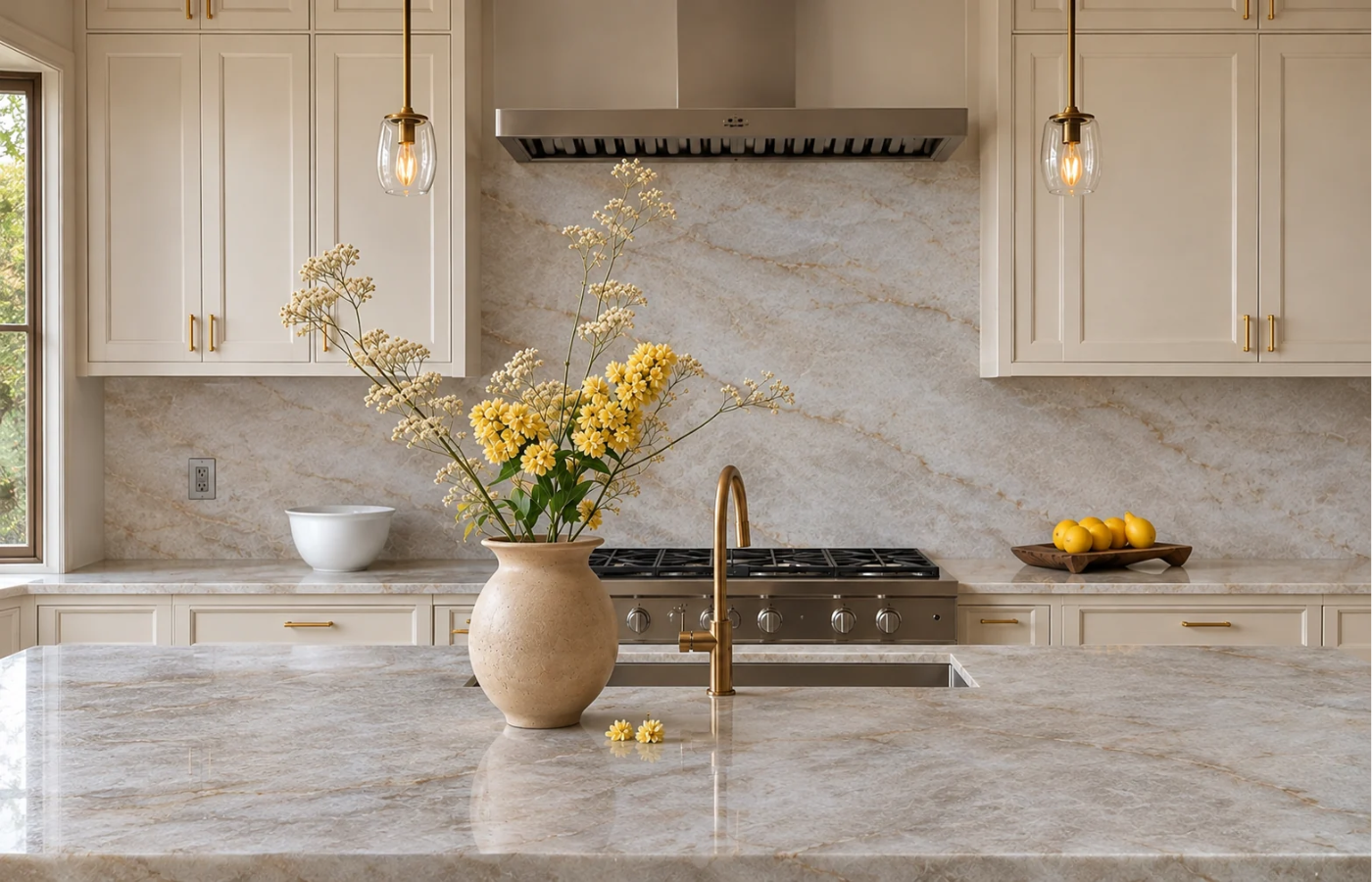
Some natural stones make a dramatic statement. Others bring a quieter kind of luxury to a space. Taj Mahal Quartzite is known for its soft ivory background, warm golden veining, and elegant natural movement that brings both beauty and character to a room.
Quarried in Brazil, Taj Mahal Quartzite is a popular choice for kitchen countertops, waterfall islands, full-height backsplashes, and bathroom vanities. Its creamy beige tones offer a marble-like appearance with the durability associated with genuine quartzite.
But is Taj Mahal Quartzite worth the investment? How much does it cost? Does it stain or etch? And what cabinet colors look best with its warm undertones?
In this Stone Spotlight, Design Surfaces explores everything homeowners should know about Taj Mahal Quartzite, including its appearance, cost, durability, maintenance, and kitchen design possibilities.
Taj Mahal Quartzite is a natural stone sourced from Brazil, recognized for its creamy ivory background and delicate veins in shades of gold, beige, taupe, and occasionally gray.
Quartzite forms when quartz-rich sandstone undergoes intense heat and pressure beneath the Earth's surface. This geological process creates a dense, crystalline material that is generally harder and more scratch-resistant than marble.
Unlike engineered quartz, which is manufactured using mineral particles and binding materials, Taj Mahal Quartzite is quarried directly from the earth.
Every slab features unique natural variations in color, veining, and movement.
According to MSI's Taj Mahal Quartzite specifications, the stone is also associated with the commercial name Perla Venata and is offered in several finishes and slab thicknesses.
Because natural stone names and classifications can vary between suppliers, always confirm the characteristics of the actual slab before purchasing.
Taj Mahal Quartzite is generally considered a warm neutral stone rather than a bright white countertop.
Its background ranges from creamy ivory to soft beige, with flowing veins that introduce subtle gold, taupe, and gray movement.
Some slabs have a relatively uniform appearance, while others feature more pronounced patterns.
The most common colors include:
These tones allow Taj Mahal to complement a wide range of cabinetry, flooring, tile, and hardware finishes.
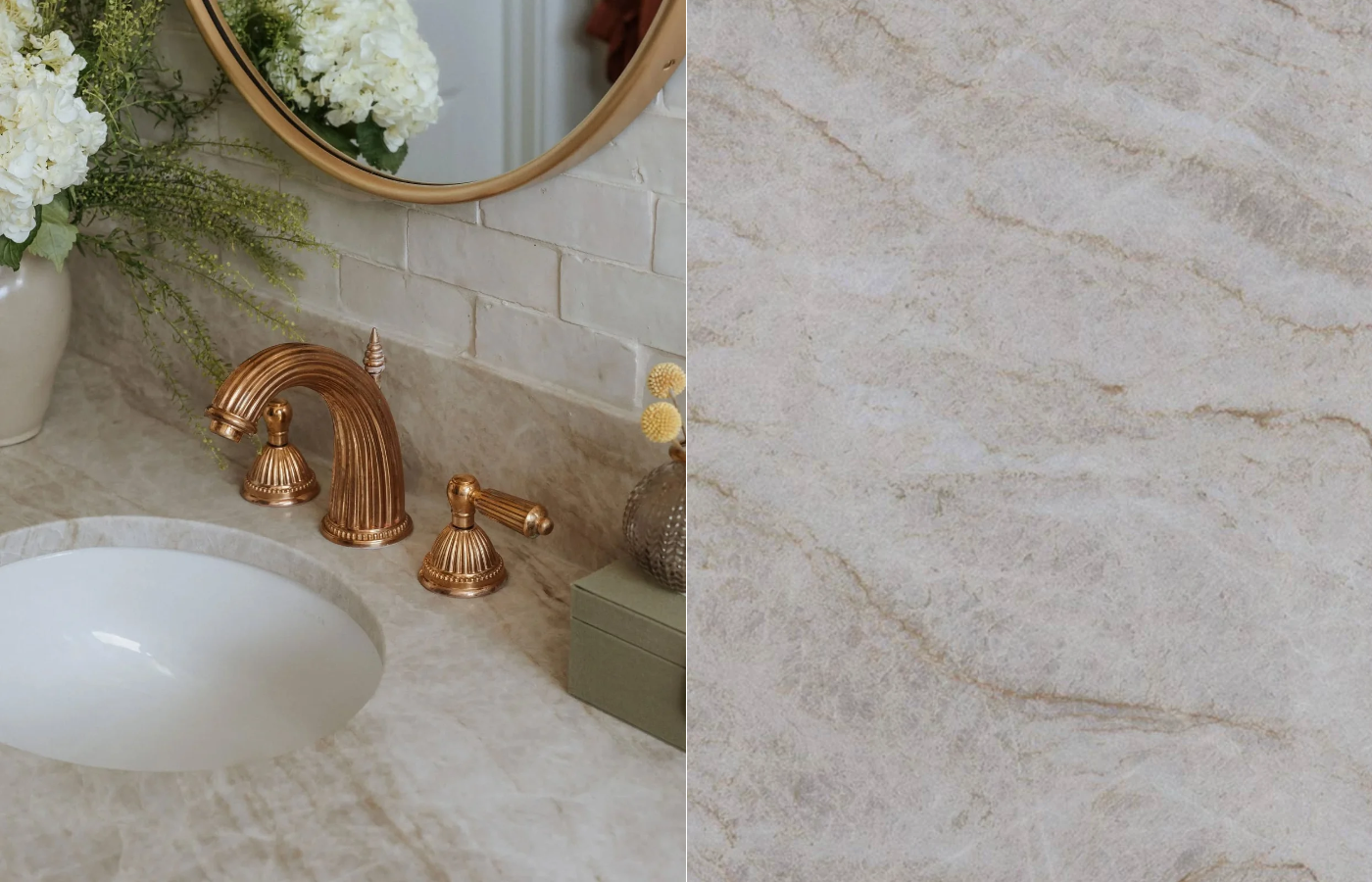
Taj Mahal is typically closer to warm ivory or beige than pure white.
While some slabs appear quite light, many contain creamy undertones that become more noticeable when placed beside bright white cabinets or cool-toned materials.
This is one reason Taj Mahal is especially popular in kitchens with natural wood, warm white cabinetry, and neutral finishes.
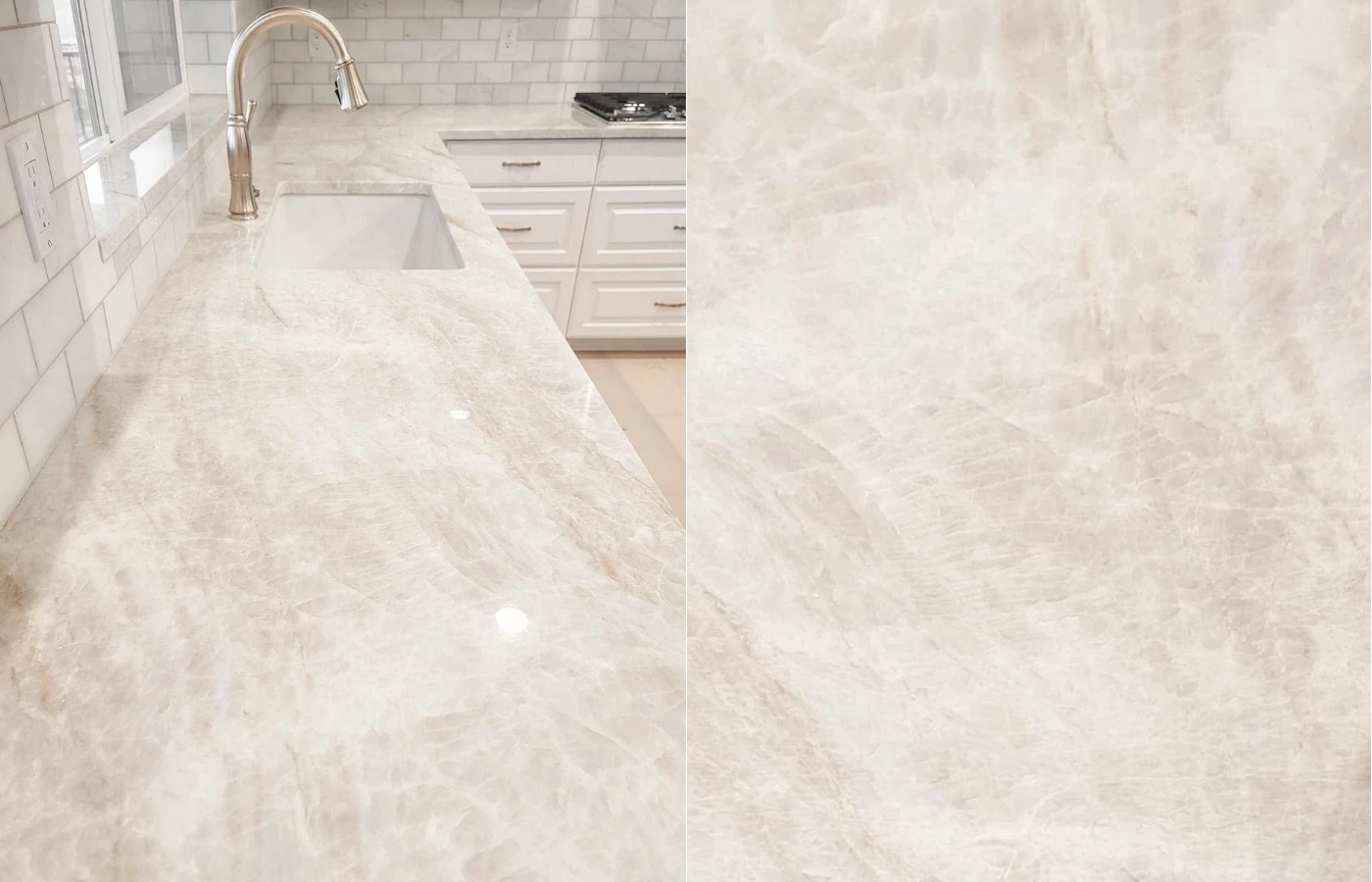
Taj Mahal Quartzite can appear more golden or yellow in certain lighting conditions, but it is not typically considered a strongly yellow stone.
Its appearance depends on several factors:
Natural slab variation: Some slabs contain more gold and beige than others.
Lighting temperature: Warm lighting can emphasize golden undertones, while cooler lighting may make the stone appear more neutral.
Cabinet colors: Bright white cabinets can make Taj Mahal's creamy tones more noticeable.
Surrounding finishes: Flooring, backsplash tile, and wall colors can influence how the stone's undertones appear.
If you want a lighter, less golden appearance, look for slabs with a predominantly ivory background and subtle gray or taupe movement.
If you prefer a warmer kitchen, slabs with more pronounced beige and gold tones may be ideal.
Design tip: Compare actual Taj Mahal slabs with your cabinet, backsplash, and flooring samples before making a final decision. The same stone can look noticeably different depending on its surroundings.
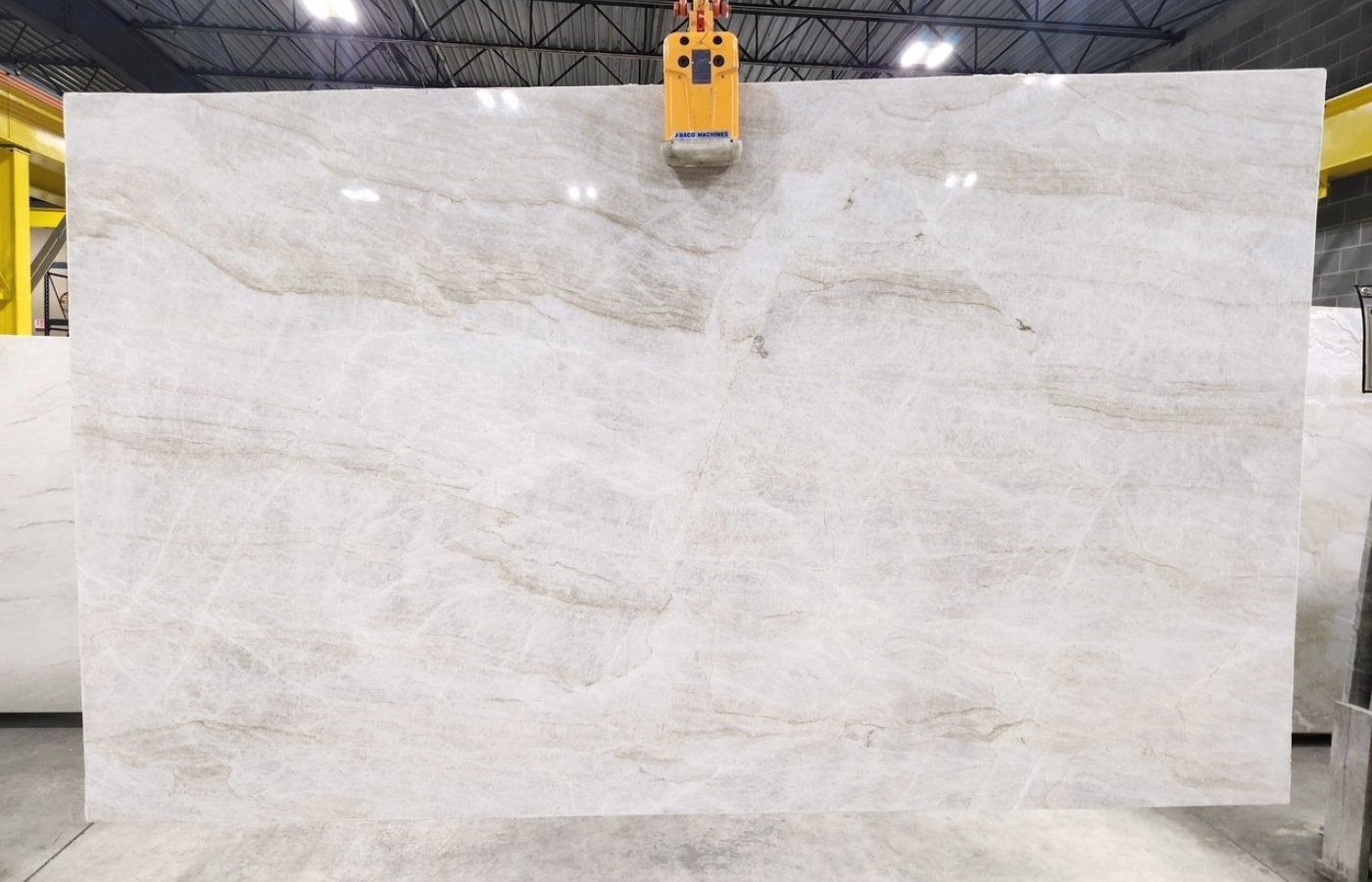
No. Every natural stone slab is unique.
Even slabs sold under the same name may differ in background color, veining, movement, and overall warmth.
One slab may feature delicate, barely noticeable veins, while another may have stronger gold or gray movement.
This natural variation is part of Taj Mahal's appeal, but it also means online photographs and small samples cannot fully represent every available slab.
For larger kitchens, islands, and full-height backsplashes, selecting slabs from the same bundle can help create a more cohesive appearance.
Taj Mahal Quartzite appeals to homeowners and interior designers because it combines natural beauty with versatility and durability.
Its warm coloring provides a softer alternative to stark white countertops, while its delicate veining adds visual interest without overwhelming the surrounding design.
Genuine quartzite is also generally harder and more scratch-resistant than marble, making it an appealing option for busy kitchens.
Taj Mahal works particularly well in:
Its understated appearance allows cabinetry, flooring, lighting, and other materials to complement the stone rather than compete with it.
Before choosing Taj Mahal Quartzite, it is important to understand both its advantages and potential limitations.
Timeless appearance: Its warm, neutral coloring works with a wide range of design styles.
Natural durability: Genuine quartzite is generally harder and more scratch-resistant than marble.
Distinctive veining: Every slab features unique natural movement and color variation.
Versatile applications: Taj Mahal can be used for countertops, islands, backsplashes, vanities, and feature walls.
Heat resistance: Natural quartzite generally offers good heat resistance, although trivets are still recommended.
Design flexibility: Its ivory, beige, and gold tones complement both light and dark cabinetry.
Premium pricing: Taj Mahal is often more expensive than entry-level countertop materials.
Natural variation: Slabs can differ noticeably in color, veining, and overall warmth.
Possible staining: Some slabs may absorb liquids and require sealing.
Fabrication requirements: Quartzite's hardness can make cutting and fabrication more demanding.
Potential etching concerns: Commercial stone classifications can vary, so the specific slab's mineral composition should be confirmed.
Maintenance: Proper cleaning and prompt spill removal remain important.
For homeowners who value natural character and an elegant appearance, Taj Mahal can offer an appealing balance of beauty and performance.
Taj Mahal Quartzite is generally considered a premium natural stone.
For preliminary budgeting, published U.S. market estimates commonly place fabricated and installed Taj Mahal Quartzite countertops around $90 to $200 per square foot, although some projects fall outside this range.
These figures are general market estimates, not Design Surfaces pricing or a quote for installation in Northeast Ohio.
The final cost depends on the actual slab, its availability, the project layout, fabrication requirements, and local labor rates.
Slab selection: Color, veining, quality, and availability can influence material pricing.
Thickness: Two-centimeter and three-centimeter slabs may have different material and fabrication requirements.
Finish: Polished, honed, and brushed finishes can vary in availability and cost.
Project layout: Large islands, corners, and unusual shapes may require additional material.
Edge profile: Decorative or complex edges can increase fabrication costs.
Sink and cooktop cutouts: Additional openings require precise cutting and finishing.
Waterfall panels: Extending the stone vertically down an island increases material use and fabrication complexity.
Full-height backsplashes: Continuing the stone up the wall adds material and installation requirements.
Fabrication and installation: Labor, transportation, support requirements, and site conditions affect the final price.
Taj Mahal may cost more than many commonly available granite varieties, but prices vary significantly.
Some premium granite slabs can be similarly priced or more expensive.
Rather than comparing stone names alone, evaluate the actual material and complete fabrication and installation estimate.
For homeowners seeking a warm, elegant natural stone with distinctive veining and strong durability characteristics, Taj Mahal can be a worthwhile investment.
Its neutral coloring works with many design styles, making it a versatile choice for kitchens and bathrooms.
However, its value depends on your budget, maintenance expectations, and how well the selected slab complements the overall design.
Yes. Genuine Taj Mahal Quartzite can be an excellent kitchen countertop material when properly selected, fabricated, and maintained.
Quartzite is generally harder than marble and offers good resistance to everyday scratching.
However, no natural stone is completely immune to damage.
Genuine quartzite is relatively scratch-resistant, but it is not scratch-proof.
Sharp objects, abrasive particles, and heavy impacts can still cause damage.
Using cutting boards is recommended rather than cutting directly on the countertop.
Quartzite generally offers good natural heat resistance.
However, placing extremely hot cookware directly on the surface is not recommended.
Sudden temperature changes, existing fissures, and certain surface treatments can create risks.
Using trivets and heat-resistant pads is the safest approach.
Yes. Like other natural stone countertops, Taj Mahal can chip along edges or corners if struck with sufficient force.
The selected edge profile, fabrication quality, and everyday use all influence the risk.
A slightly softened edge may be more practical than a sharp, delicate profile in a busy kitchen.
Taj Mahal Quartzite can stain under certain conditions, and its resistance to etching depends on the actual stone's composition.
This is an important consideration for homeowners comparing natural stone materials.
Some quartzite slabs are more absorbent than others.
Potential staining sources include cooking oils, coffee, wine, strongly colored foods, and certain cleaning products.
Prompt cleanup helps reduce the risk of staining.
A suitable penetrating sealer may provide additional protection when recommended for the specific slab.
True quartzite is generally more resistant to acid etching than marble.
However, commercial stone names do not always guarantee identical mineral composition.
Some materials sold as quartzite may contain acid-sensitive minerals.
Ask your supplier or fabricator about the specific slab and its recommended care requirements.
Sealing requirements vary depending on the stone's porosity, finish, and any existing treatments.
Some Taj Mahal slabs may benefit from a penetrating sealer, while others may require less frequent treatment.
A qualified stone professional can evaluate the slab and recommend an appropriate approach.
Sealing does not make natural stone completely stain-proof.
For additional natural stone maintenance guidance, visit the Design Surfaces Care & Maintenance page.
Taj Mahal is frequently compared with marble because both materials can feature light backgrounds and elegant natural veining.
However, there are important differences.
Taj Mahal typically features warm ivory, beige, and gold tones.
Marble is available in a wider range of colors and patterns, including bright white varieties with pronounced gray veining.
Genuine quartzite is generally harder and more resistant to scratching than marble.
Marble is typically more vulnerable to acid etching.
True quartzite is generally more acid-resistant, although the specific slab's composition should be verified.
Both materials benefit from appropriate cleaning and care.
Sealing requirements depend on the individual stone.
Taj Mahal may appeal to homeowners who want warm, marble-like movement with the performance characteristics of genuine quartzite.
Marble may appeal to those who prefer its particular appearance and are comfortable with its greater sensitivity to acidic substances.
The best choice depends on the design, budget, and intended use.
One of Taj Mahal's strongest design advantages is its compatibility with a wide range of cabinet colors.
Its creamy background and subtle gold veining make it especially effective in kitchens that incorporate natural materials and warm finishes.
White oak is one of the most complementary cabinet materials for Taj Mahal.
The natural wood grain enhances the stone's beige and gold undertones while maintaining a light, airy appearance.
This combination works particularly well in organic modern, transitional, and Scandinavian-inspired kitchens.
Consider soft white walls, brushed brass hardware, and a simple backsplash to complete the look.
White cabinetry creates a clean, timeless appearance.
However, the exact shade matters.
Because Taj Mahal often has warm undertones, soft white or warm off-white cabinets may create a more cohesive combination than extremely cool whites.
Compare cabinet samples directly against the slab before making a final selection.
Cream cabinetry creates a soft, layered neutral palette.
This combination works well in traditional, transitional, and European-inspired kitchens.
To introduce contrast, consider darker flooring, warm wood accents, or distinctive hardware.
Walnut cabinetry provides rich, warm contrast against Taj Mahal's light background.
The combination creates a sophisticated appearance without relying on stark black-and-white contrast.
A full-height Taj Mahal backsplash can help visually connect darker cabinets with lighter countertops.
Deep charcoal, espresso, and certain dark green cabinet colors can create a dramatic contrast.
The stone's light background helps brighten the room, while its warm veining softens the overall palette.
This pairing can be especially effective in contemporary kitchens with thoughtfully planned lighting.
Because Taj Mahal already features natural movement, many homeowners prefer backsplashes that complement rather than compete with the countertop.
Using the same stone for both countertops and backsplash creates a cohesive, luxurious appearance.
The natural veining can continue vertically, highlighting the stone's movement.
This approach works particularly well behind ranges and on large uninterrupted walls.
Warm white subway tile creates a classic combination.
Choose a shade that coordinates with Taj Mahal's creamy undertones.
A slightly textured or handmade-look finish can add interest without overwhelming the design.
Zellige-style tile introduces subtle variation, texture, and light reflection.
Warm white, ivory, and soft beige shades can complement Taj Mahal beautifully.
Simple porcelain tile provides a clean backdrop.
This works particularly well when the countertop is intended to remain the primary visual feature.
Explore tile options at Design Surfaces when selecting backsplash materials for your kitchen.
Taj Mahal's warm neutral palette makes it easy to coordinate with surrounding finishes.
Brushed brass: Enhances the stone's gold and beige undertones.
Champagne bronze: Creates a soft, warm metallic accent.
Brushed nickel: Provides a versatile, understated appearance.
Matte black: Adds contrast in modern and transitional kitchens.
Polished chrome: Can complement brighter contemporary designs.
Natural white oak and warm-toned wood flooring pair particularly well with Taj Mahal.
Light beige, taupe, and greige flooring can also complement its neutral palette.
For homeowners seeking a durable wood-look alternative, luxury vinyl flooring offers a variety of colors and textures.
The goal is to coordinate undertones rather than match every material exactly.
The finish can significantly change Taj Mahal's appearance.
According to MSI's product specifications, Taj Mahal is available in polished, honed, and brushed finishes, although availability varies by supplier.
A polished finish creates a reflective surface that emphasizes the stone's depth and natural veining.
It is a popular choice for homeowners seeking a bright, refined appearance.
Honed quartzite has a matte or low-sheen appearance.
This finish creates a softer, more understated look that works well in contemporary and organic interiors.
Some honed surfaces may show oils or handling marks differently from polished stone.
A brushed finish introduces subtle texture and a less reflective appearance.
It can create a more tactile, natural aesthetic.
Because texture affects cleaning and maintenance, ask about the care requirements for the specific finish.
Choose polished if you prefer a luminous, reflective surface.
Choose honed if you want a softer, matte appearance.
Consider brushed if you prefer subtle texture and an organic feel.
Always compare actual samples before making a decision.
Taj Mahal can be incorporated into a variety of kitchen layouts and design styles.
A large kitchen island provides an opportunity to showcase the stone's flowing veining.
Pair Taj Mahal with white oak or walnut cabinetry for a warm, inviting focal point.
A waterfall countertop extends the stone vertically down the side of the island.
This creates an architectural appearance and emphasizes the natural pattern.
For a cohesive result, discuss vein direction and slab matching with your fabricator.
Using the same stone across horizontal and vertical surfaces creates visual continuity.
It can also reduce the number of competing materials in the kitchen.
Try light perimeter cabinets with a darker wood island.
Taj Mahal can connect the two finishes through its warm neutral coloring.
Taj Mahal also works beautifully on bathroom vanities.
Its creamy coloring pairs well with natural wood, warm metallic fixtures, and neutral tile.
For bathroom applications, consider the selected finish's maintenance requirements.
Proper care helps preserve the stone's appearance over time.
For everyday cleaning:
Avoid unapproved acidic cleaners, abrasive powders, and harsh chemicals.
Blot spills promptly, especially oils and strongly colored liquids.
Use cutting boards and trivets to protect the countertop from unnecessary wear.
Follow your supplier's or fabricator's recommendations for sealing and long-term care.
For additional guidance, explore the Design Surfaces Care & Maintenance page.
Selecting the actual slab is one of the most important steps in a natural stone project.
Online photos can provide inspiration, but they cannot fully capture the color variation, depth, and movement of a particular slab.
Before purchasing, consider these factors.
Is the slab more ivory, beige, gold, or gray?
Compare it with your cabinet, flooring, and backsplash samples.
Do you prefer subtle, consistent movement or more dramatic veining?
Consider how the pattern will appear across the countertop layout.
Confirm that the available slab sizes work with your island, countertop runs, and backsplash plans.
Ask about thickness options and how they affect edge details, support, and fabrication.
Compare polished, honed, and brushed samples under lighting similar to your home.
Ask about porosity, fissures, resin treatments, sealing recommendations, and any characteristics that may affect fabrication or maintenance.
For large islands and full-height backsplashes, review the proposed layout before cutting.
Thoughtful slab selection can make a significant difference in the finished design.
Taj Mahal is sold as natural quartzite, typically sourced from Brazil. However, commercial stone names do not always guarantee identical mineral composition across suppliers. Confirm the characteristics of the specific slab before purchasing.
Taj Mahal is generally considered a premium natural stone. Published U.S. estimates commonly place fabricated and installed countertops around $90 to $200 per square foot, although actual pricing varies by slab, location, and project requirements.
Some slabs may absorb liquids, especially oils and strongly colored substances. Prompt cleanup and appropriate sealing when recommended can help reduce staining risks.
Taj Mahal typically features warm ivory, beige, and gold tones. Some slabs may appear more golden under warm lighting or beside cool white cabinetry. Viewing actual slabs alongside your other materials is the best way to evaluate the color.
Taj Mahal's neutral coloring and subtle natural movement make it adaptable to many design styles. Its appearance works in traditional, transitional, and contemporary interiors, although personal preferences and design trends can change.
Taj Mahal Quartzite combines warm ivory coloring, subtle golden veining, and natural stone durability in a material that complements a wide range of interiors.
Whether you're designing a kitchen with white oak cabinets, creating a waterfall island, or selecting a bathroom vanity, Taj Mahal offers an elegant foundation with distinctive natural character.
The most important step is selecting a slab that complements your design and understanding its specific characteristics before fabrication and installation.
At Design Surfaces in Westlake, Ohio, our team helps homeowners, designers, and contractors throughout Cleveland and Northeast Ohio explore premium countertop materials and coordinate tile, flooring, sinks, faucets, and hardware.
Visit Design Surfaces at 24000 Sperry Drive, Westlake, OH 44145, or call 440-899-9900 to explore countertop materials for your project.
Natural Stone Disclaimer: This Stone Spotlight is intended as a general introduction to the featured material. Natural stone varies from slab to slab, including differences in color, veining, pattern, mineral composition, and surface characteristics. Pricing, availability, finishes, durability, and maintenance requirements may also vary by supplier and individual slab. We recommend viewing actual slabs and confirming material specifications and care recommendations before making a final selection.


